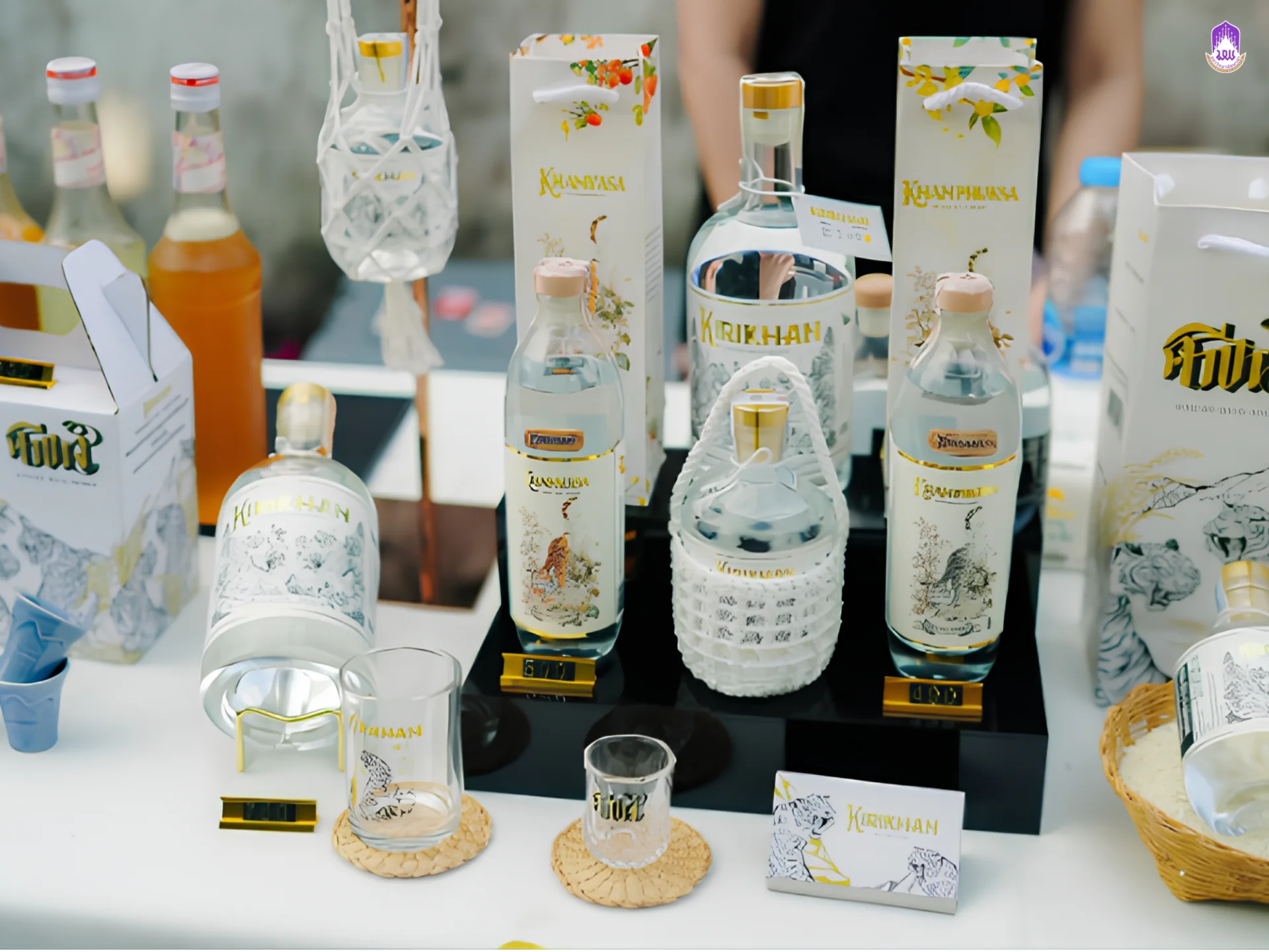
I begin this story with the most striking image: a roaring tiger on a clear glass bottle. Without someone telling me, I would never have guessed that this tiger pattern originated from a tattoo on the back of a grandfather, the original distiller of a family in Jun District, Phayao Province. This is the origin of "KIRIKHAN," a community distilled spirit from the Kamnan Det Community Enterprise. They don't just sell flavor; they sell memories and bonds forged through "RD6" sticky rice grown right in the soil of Phayao.
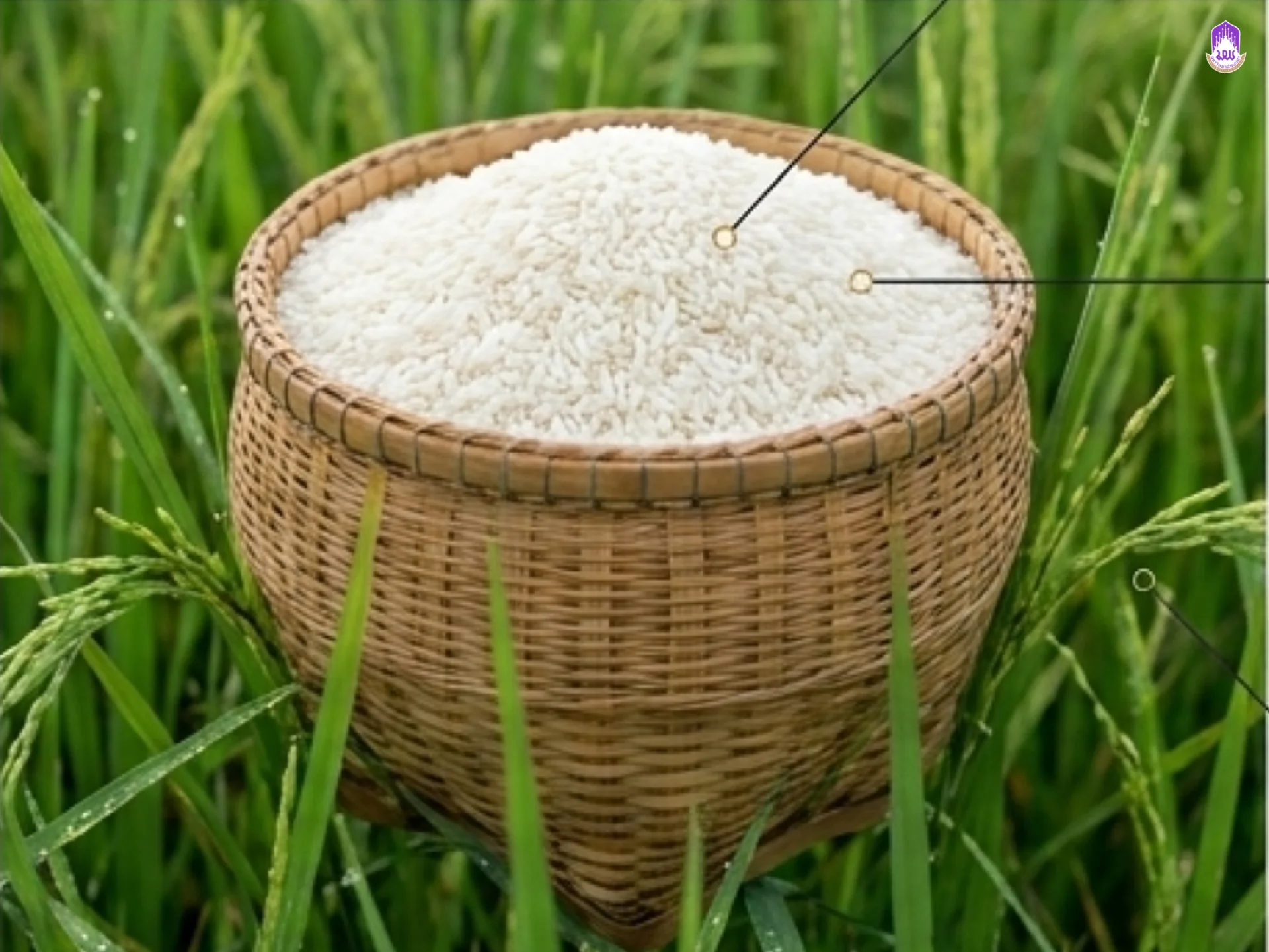
It sounds romantic, doesn't it? However, every community distillery like this hides the exact same problem.
When "Guesstimating" Is No Longer Enough for the Global Market
In the Northern dialect, "Ka-ao" means to estimate roughly without exact measurements. Traditionally, community distilled spirits relied on this kind of art—the "memory" and "senses" of the local distiller. They brewed by feeling and smelled through a lifetime of accumulated experience. No one could argue with the delicious taste, but if asked whether the flavor or quality was consistent every single time, the answer was not always certain. This is the exact hurdle preventing local spirits from stepping onto the international stage, which demands consistency, verifiable quality, and cost-effectiveness in every production cycle.
The turning point arrived when a research team led by Asst. Prof. Dr. Erawin Thavorn, the project leader, along with Asst. Prof. Dr. Sutham Arun and Assoc. Prof. Dr. Aphisak Witthayaprapakorn, encountered the KIRIKHAN distillery. Under the Reinventing University project (a university reform initiative to apply knowledge towards developing the grassroots economy) in 2025, the research team wasn't looking for a massive factory, but rather the "dedication of the community". KIRIKHAN had it all: excellent ingredients and a unique flavor. The only thing missing was scientific confidence to complement, not replace, their traditional wisdom.
In reality, this enterprise plays a much larger role than merely distilling spirits for sale. Every bottle produced translates to village employment and added value for the rice grown by local farmers. This is a grassroots economy in a truly tangible sense, not just fancy words in a project document.
When Engineers Tackle the Problem
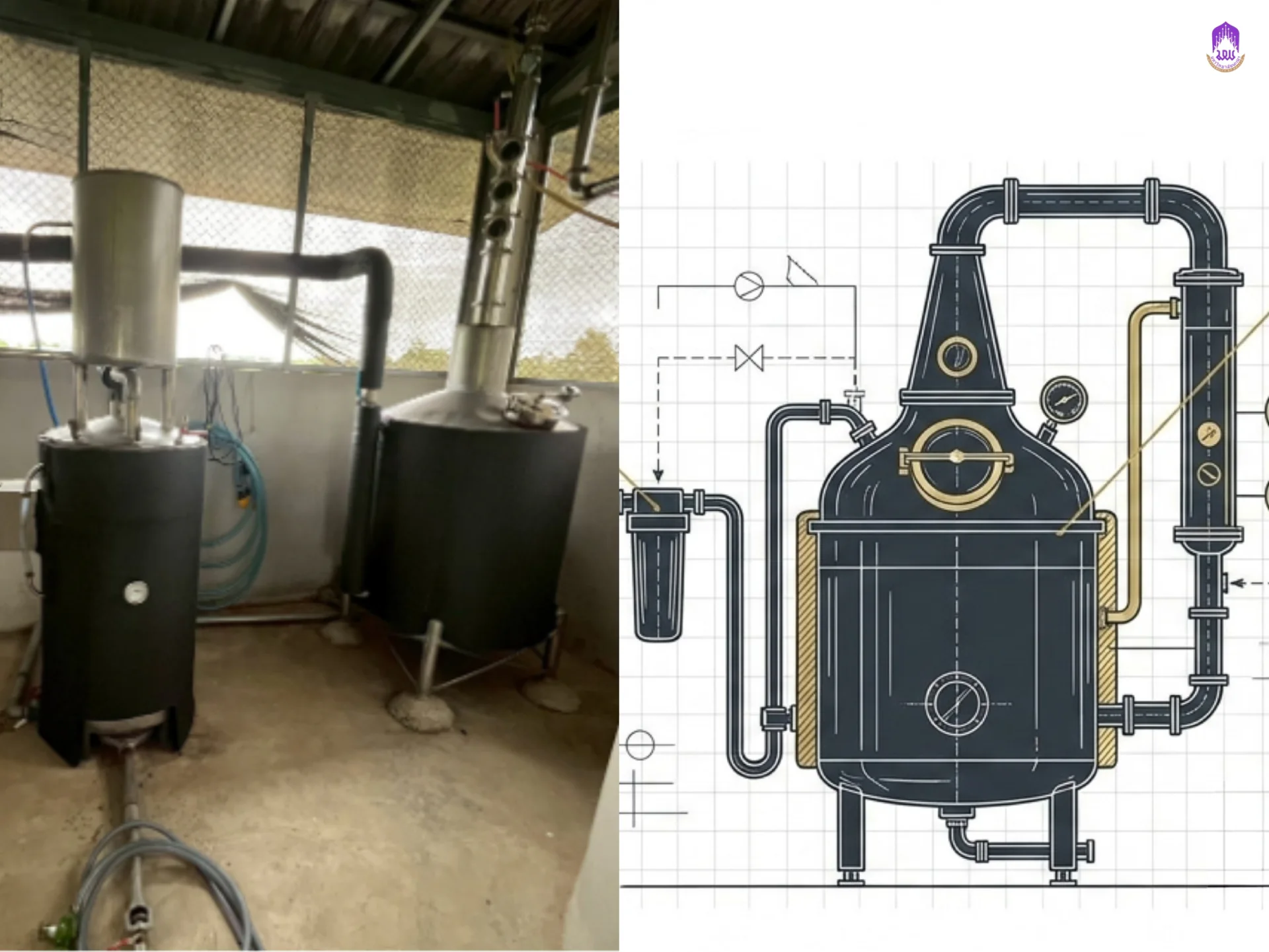
The research team went into the field to collect serious data and discovered that the traditional distillation system lost a massive amount of energy due to inefficient heat transfer. The steam boiler suffered from scaling caused by highly hard groundwater, and there was no systematic energy control system in place.
If we talk about the heart of the entire distillery system, it is undeniably the steam boiler. It's not just a piece of equipment dictating production volume; it is a critical point that requires special control purely for safety reasons. Steam boilers operate under high pressure and temperature at all times. If designed or operated incorrectly, there is a risk of severe accidents, including explosions. For this reason, the design and installation must be certified by engineers with actual specialized knowledge, not just based purely on experience as in the past. The frontline operators must also possess sufficient knowledge to correctly operate and maintain the boiler, preventing accidents from harming themselves and those around them.
 |
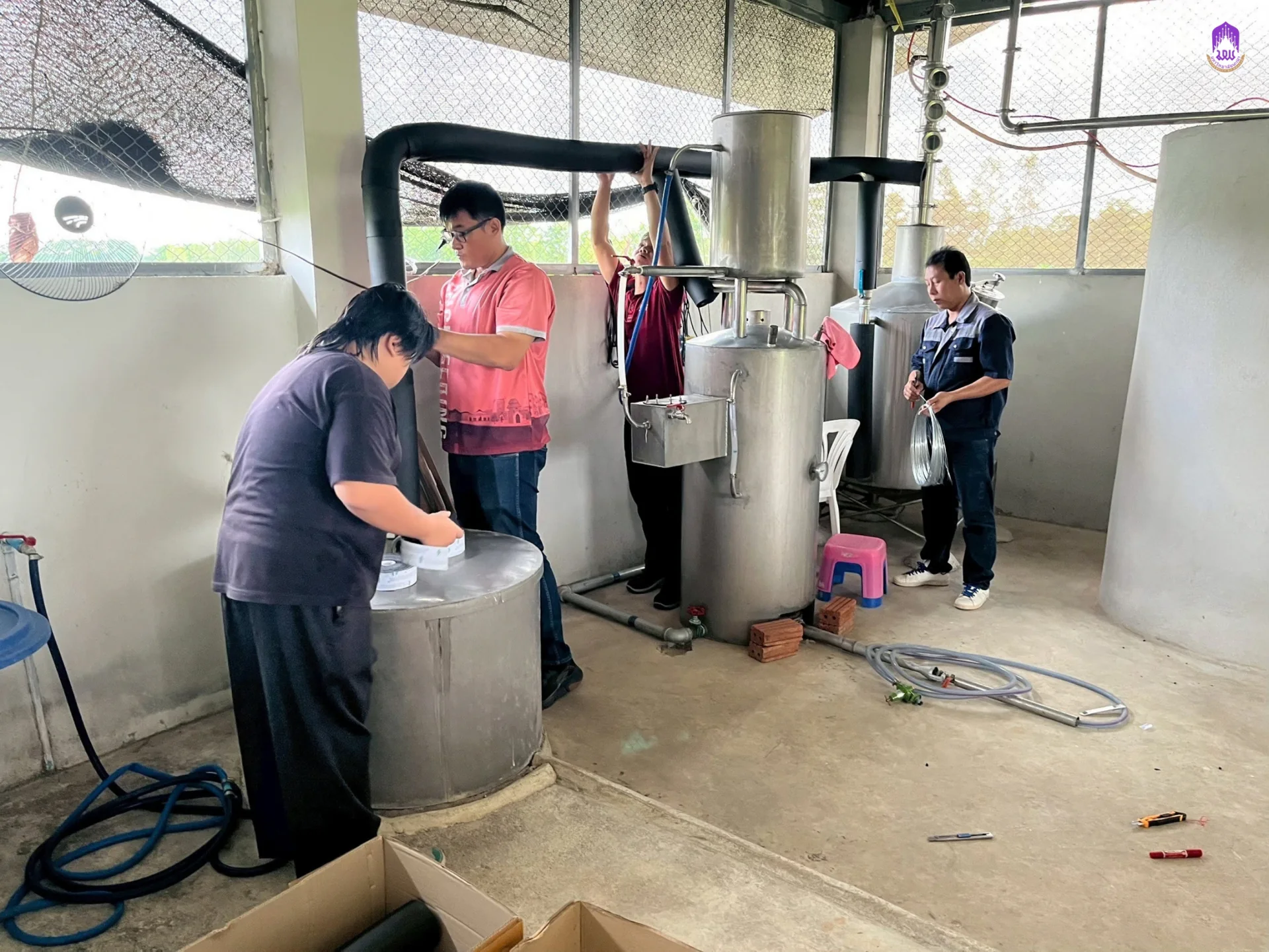 |
The solution chosen by the researchers, therefore, wasn't solely about energy conservation but simultaneously prioritized the safety of the boiler as a primary objective. The actions taken included installing a water filtration system to reduce hardness and prevent scale accumulation in the boiler, which, if left unchecked, would cause abnormal heat transfer and increase the risk to the boiler itself. They also applied thermal insulation at critical points of the distillation system to reduce energy leakage. Concurrently, they transferred knowledge and provided hands-on training for the enterprise members regarding quality control and safe steam boiler operation. This empowered them to confidently manage the system on their own, rather than relying on researchers forever.
Numbers That Speak for Themselves
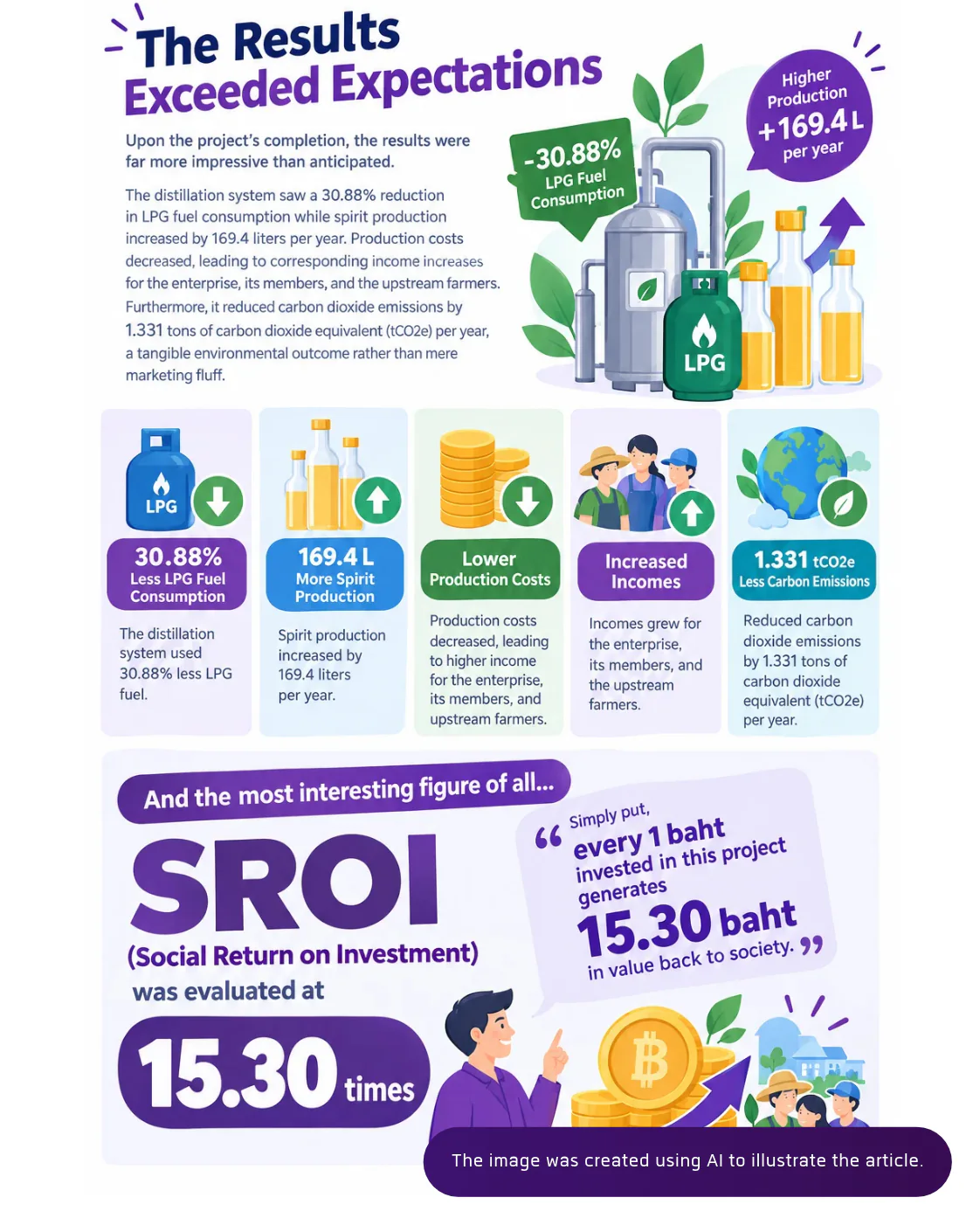
Upon the project's completion, the results were far more impressive than anticipated. The distillation system saw a 30.88% reduction in LPG fuel consumption while spirit production increased by 169.4 liters per year. Production costs decreased, leading to corresponding income increases for the enterprise, its members, and the upstream farmers. Furthermore, it reduced carbon dioxide emissions by 1.331 tons of carbon dioxide equivalent (tCO2e) per year, a tangible environmental outcome rather than mere marketing fluff.
However, the most fascinating figure to me is the SROI (Social Return on Investment), which was evaluated at 15.30 times. Simply put, every 1 baht invested in this project generates 15.30 baht in value back to society. These are not just pretty numbers in a report; they are proof that this type of area-based research creates high-level, real-world economic and social impact. It serves as a model proving that universities can be an engine for Area-based Development, tangibly connecting knowledge, technology, and lifelong learning.
This project is anchored in Sustainable Development Goal 7, or SDG 7 (Affordable and Clean Energy), as its core. It aims to reduce energy consumption and boost efficiency in the distillation process through technology tailored to the actual local context, rather than forcing external technologies upon them.
From a Secret Recipe in the Mind to a Manual Anyone Can Follow
The story doesn't end here. The most crucial turning point identified by the research team was transforming the wisdom stored in the mind of a single distiller into a transferable standard. The following year, the School of Engineering received follow-up funding under the "1 Faculty 1 Sustainable Development Goal (SDG)" project from the University of Phayao to further elevate the production quality control process. Consequently, the School of Engineering collaborated with Lecturer Newitchaya Wutthinithisanand from the School of Agriculture and Natural Resources at the University of Phayao, who stepped in to assist in establishing production standards.
From then on, what used to rely solely on the distiller's "memory" and "senses" was extracted by the researchers into a Standard Operating Procedure (SOP). This wasn't an erasure of traditional wisdom, but rather documenting it as a manual that anyone could build upon. This transition elevated "KIRIKHAN" from being just a community spirit selling the charm of local wisdom into a fully-fledged "Craft Spirit," firmly backed by research and engineering principles.
Once the standards were solidified, doors to new markets naturally opened. This was especially true for tourists and consumers seeking high-quality local spirits, who value local products and Thai wisdom just as much as the flavor.
When Science and Engineering Push Wisdom Toward Standardization
The story of KIRIKHAN reminds me of a sentence that perfectly summarizes everything: "Science and engineering do not exist to destroy the charm of the community, but to elevate wisdom into a standard ready for sustainable competition on a global scale.".
From a distillation jar in a small village in Jun District, KIRIKHAN today is no longer just the tale of a single family. It is a story of collaboration between a community and a university. It proves through hard numbers that when local wisdom meets science that understands and respects its roots, the result is not just a better spirit, but sustainability that flows back to everyone in the production chain—from the upstream farmers to the consumers today.